Joint Pain After Workouts: What’s Normal & What to Do
When post-workout joint pain is common—and when it’s not
Training can leave you feeling “worked,” but joints shouldn’t feel threatened. A helpful first step is separating muscle soreness (DOMS) from joint irritation. DOMS tends to feel like broad tenderness and stiffness in the muscle belly. Joint pain is more often deep, sharp, pinchy, or unstable—like it’s coming from a specific line or point in the joint.
Mild joint achiness can happen after a new stimulus and still be normal if it improves as you warm up, doesn’t come with swelling, and resolves within 24–72 hours. It’s more concerning when you notice swelling, heat, redness, locking/catching, buckling, numbness/tingling, or a pattern where pain worsens each session.
Pay attention to patterns: pain only at end-range often points to irritation or mobility/control mismatch; pain under load often points to technique, setup, or too much volume; pain the next morning is frequently a recovery and load-management signal. A quick rule: if pain changes your gait, grip, or bar path, modify immediately.
| Signal | More like DOMS | More like joint irritation |
|---|---|---|
| Location | Muscle belly, broad area | Specific joint line (kneecap, hip crease, shoulder front, elbow) |
| Feel | Dull, tender, stiff | Sharp, pinchy, catching, unstable |
| Warm-up effect | Often improves during session | May worsen with repeated reps/impact |
| Swelling/heat | Uncommon | More common |
| Timing | Peaks 24–48h after | Can start during activity or right after |
The most common training causes (and what they look like)
Most exercise-related joint pain isn’t mysterious—it’s usually a mismatch between what the joint is ready for and what the plan demanded.
- Too much, too soon: A sudden jump in mileage, intensity, or lifting volume often creates a predictable “threshold” where discomfort appears mid-session.
- Repetitive impact + fatigue: Form tends to unravel late in a run or late sets, turning small errors into repeated joint stress (knees, ankles, hips; shoulders, elbows).
- Range-of-motion mismatch: Deep squats, deep pressing, or aggressive bottom positions without enough control can produce a “pinch” at the end range.
- Technique and load placement: Knees caving, overstriding, elbow flare, or excessive lumbar extension typically hurts during the same rep phase every time.
- Under-recovered tissues: Poor sleep, high stress, low calories, and low protein can make joints feel cranky even at normal workloads.
- Footwear/surface (runners): Worn shoes, abrupt transitions to minimalist shoes, heavy camber, or consistently hard surfaces can be enough to tip you into irritation.
- Equipment setup (lifters): Bar position, grip width, bench angle, and stance are small levers that can meaningfully reduce joint stress fast.
Runner-specific joint pain triggers and fixes
Knee pain
Knee discomfort commonly tracks with rapid mileage increases, extra downhill running, or abrupt cadence/stride changes. The first move is usually load control: flatten the weekly ramp-up and keep the next long run conservative if you just added speed. Pair that with quad and hip strength work so the knee isn’t asked to absorb everything at the same intensity.
Ankle/Achilles irritation
A spikes-in-workload story is common here: speed sessions, hills, or a shoe change. Keep easy days truly easy, reduce high-strain elements temporarily, and build calf capacity gradually (slow eccentrics, isometrics, and progressive single-leg work).
Hip pain
Weekly setup that protects joints
Lifter-specific joint pain triggers and fixes
Shoulder pain
Elbow pain
Knee pain
Wrist pain
Technique-first troubleshooting
Recovery basics that actually reduce joint pain
For more background on joint symptoms and when they may matter, see MedlinePlus: Joint Pain and Mayo Clinic: Knee pain. For smart progression concepts, the ACSM resources on training principles are a solid reference point.
A simple “modify, don’t quit” plan for the next 7–14 days
| If pain shows up with… | Try this modification | Goal |
|---|---|---|
| Running impact | Replace 1–3 runs with cycling/rowing; keep one short easy run | Maintain aerobic fitness while reducing joint stress |
| Deep knee bend under load | Box squat, tempo squat, or reduce depth briefly | Keep strength work without end-range irritation |
| Overhead pressing | Neutral-grip dumbbell press or landmine press | Train pushing with shoulder-friendly angles |
| Heavy pulls with grip strain | Use straps selectively, vary grips, reduce top sets | Keep posterior-chain training while calming elbow/wrist |
When to get help
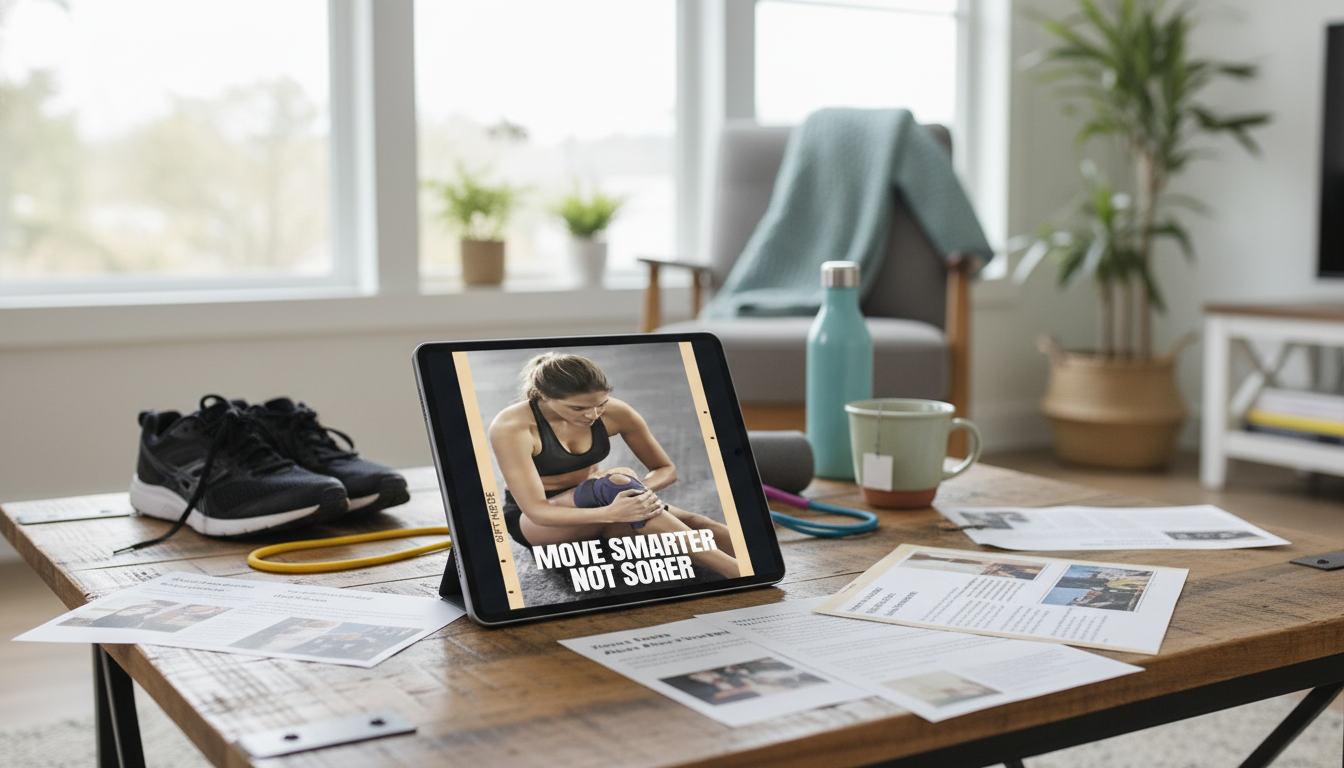
Download: Move Smarter, Not Sorer
If you want a single reference you can reuse whenever a joint gets cranky, Move Smarter, Not Sorer – Joint Pain from Exercise Causes Guide (download) is built for runners and lifters who prefer clear triggers, practical substitutions, and a steady return-to-training plan.
To keep your shoes, belts, and training gear performing longer—especially when you’re rotating surfaces or modifying workouts—pair it with Train Smarter and Make Your Gear Last – Sports Gear Care Guide (download).
FAQ
Should training stop completely if a joint hurts after exercise?
Usually no—modify, don’t quit: reduce the aggravating variable (impact, load, volume, range, speed, or grip) and keep pain-free movement so conditioning and skill don’t backslide. Stop and seek care sooner if you have swelling, instability, locking/catching, numbness, or a sudden loss of function.
How long should joint pain last after a workout?
A mild ache that eases with warm-up and resolves within 24–72 hours is often manageable. Pain that persists beyond that window—or keeps escalating with each session—commonly signals a workload jump, technique issue, or recovery shortfall that needs adjustment.
Is clicking or popping in a joint a bad sign?
Painless clicking can be normal, especially if it isn’t paired with swelling or loss of function. Painful popping, catching/locking, swelling, or a feeling of instability is a reason to reduce load and get evaluated.











Leave a comment